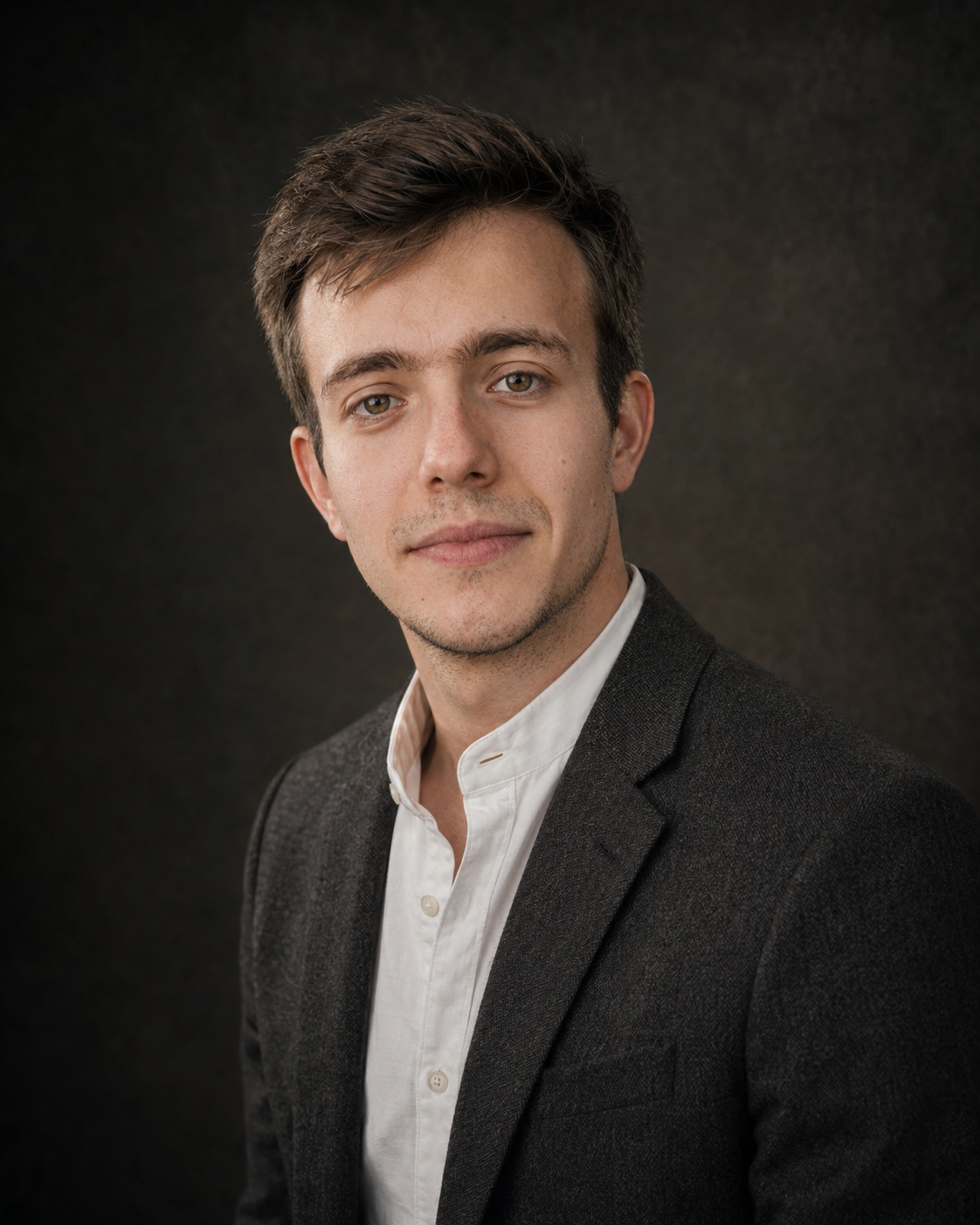
Welcome to my academic haven! I am Jan and I live in Slovakia with my wife Anna and I’m interested in the structure of reality and its deepest principles.
PhD student
Department of Applied Informatics
Comenius University in Bratislava
Slovakia
Curriculum Vitae · Publications & Talks · Teaching & Supervision · Projects, Grants & Awards · Outreach · Posts
research
My work comes back to one question: how much of a structure’s global behaviour is already settled by its local parts? In graph theory this becomes very concrete. A graph can be completely rigid — asymmetric, with no nontrivial automorphism — and yet still be full of partial symmetries (partial automorphisms): small pieces that could be swapped if you only ever looked at them locally. I study those partial automorphisms, and the inverse monoids they form, and how far you have to look before a local symmetry either extends to a global one or breaks. That “how far” is what I call asymmetric depth (if the structure under consideration is asymmetric).
The same tension drives some of the oldest problems in the field. The graph reconstruction conjectures ask it directly — whether a graph is determined by / uniquely reconstructible from the collection of its subgraphs. The graph isomorphism problem — given two finite graphs, can a computer quickly decide if they are isomorphic? Usually, to find an isomorphism, you try to pass local information across the graph to build a global picture (like the Weisfeiler-Lehman algorithm, which iteratively colors nodes based on their neighbors’ colors). Ultimately, graph isomorphism is hard because local uniformity might hide global uniqueness. You cannot easily “stitch together” local invariants into a definitive global mapping without hitting a wall of symmetry that requires exponential guessing to resolve.
Sparsity is where this stops being abstract. Real networks — brains among them — are sparse, because connections cost something, and sparse classes are exactly where the bounds for asymmetric depth get sharper.
What keeps me interested is that this tension between local and global, partial and total is not just about graphs. The threshold where local rules fail to dictate global states is the core mystery of emergence. See my little project I made with Claude https://janpastorek.com/scientific_theories_reality_ladder/#complexity
More recently, with the advent of LLMs and groundbreaking results, I have been interested in AI and automated reasoning, especially in math. Can we teach AI to prove conjectures? Can it itself generate interesting conjecture … to carve at the joints? What are interesting conjectures?
research interests
- algebraic graph theory, particularly graph isomorphism problem, graph reconstruction conjecture, asymmetric graphs and partial automorphism inverse monoids of graphs and Weisfeiler-Leman algorithm see the work
- complex adaptive systems, particularly “how can emergent states appear in complex systems?” see the work
- AI for mathematics, particularly automated conjecturing, refutation and formalization see the work
further interests
- history and philosophy of science and mathematics
- cognitive science, particularly semantic structure in embedding spaces of machine learning models and the history of the field see the work
- quantum nonlocal games, particularly application AI (reinforcement learning) for violating Bell inequalities see my bachelor thesis and my research internship